
Western route secures Austria's gas supply

During the current winter season – specifically between October 2025 and the end of January 2026 – 34 TWh flowed from Germany to Austria, a sixfold increase in gas flows compared to the same period last year. West-east transport via WAG has thus developed from a supplementary to a central supply route.
Meanwhile, Austria strengthened its position as a key transit hub for the CEE region. Of the volumes imported via the long-distance pipeline, 42% were re-exported, primarily to Hungary (29%), with smaller amounts going to Slovenia (8%) and Slovakia (5%).
Gas consumption significantly above previous year's level
Gas consumption in Austria in 2025 was around 81 TWh, approximately 9% higher than in the previous year. Consumption was significantly higher than in the same months of the previous year, particularly in February 2025 (+46%) and October 2025 (+22%). Sales of highly efficient gas heating systems also rose again in 2025 by 10%, whereas demand for heat pumps fell by 22%. This once again confirms the important role of natural gas, especially in the colder months.
Storage levels reflect high consumption
At the beginning of winter, storage levels were already around 10% below last year's levels. As of 22 February 2026, the average storage level in the CEE region under review (Austria, Czechia, Slovakia, Hungary and Ukraine) was around 31%. Compared to the previous year, this represents a decline of around 7% and illustrates the increased use of storage facilities during the winter months.
In Austria, the fill level on 22 February 2026 was 37%, which was around 28% below the previous year's figure. The higher withdrawal reflects increased demand and underlines the role of storage facilities as a seasonal balancing instrument.
WAG Loop 1 increases supply security
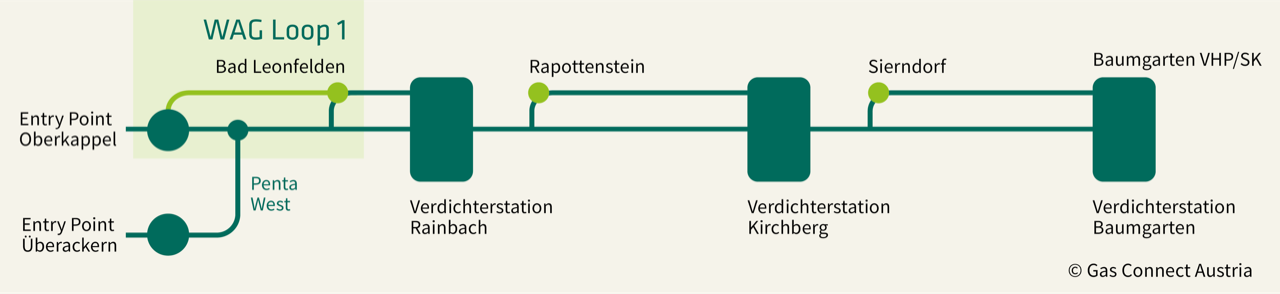
The changes in gas flows clearly show that the west-east route via Austria, with Baumgarten as a hub in the heart of Europe, is an indispensable connection for the CEE region. This is precisely where Gas Connect Austria comes in with the WAG Loop 1 project: a 40-km parallel strand of the West Austria gas pipeline between Oberkappel and Bad Leonfelden, which will increase transport capacity from Germany by around 30% (approx. 27 TWh per year). This will significantly increase security of supply in Austria and the CEE region.
In view of the Commission's REPowerEU targets, which envisage phasing out Russian gas imports, the project is becoming even more important for the region's supply. At the same time, WAG Loop 1 is being designed to be hydrogen-compatible, thus forming the basis for future H₂ transport along the west-east route.
The Tyrol and Vorarlberg regions are not included in this assessment of the Eastern market area and have always been supplied from Germany.