

Austria consumes more gas in 2025 so far
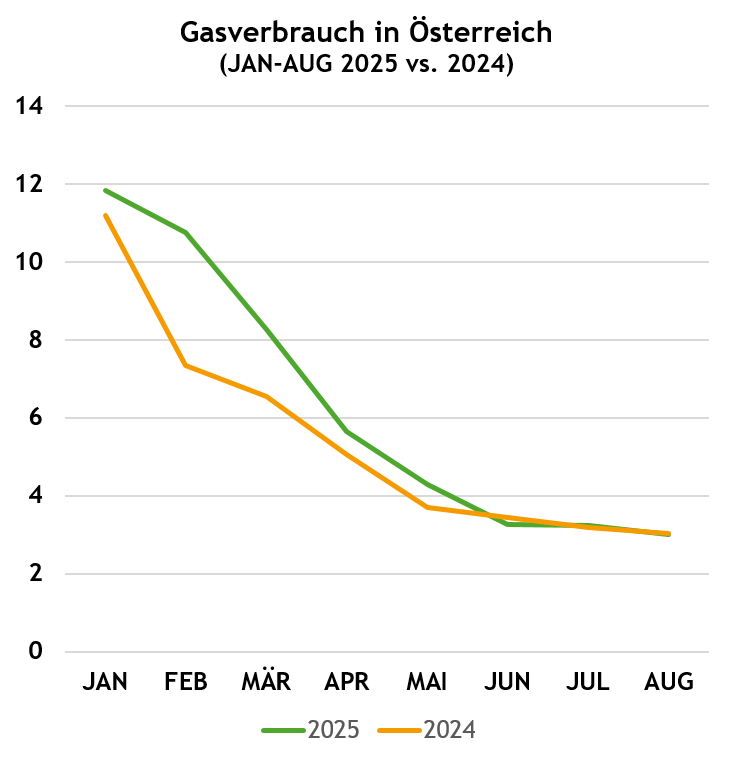
In concrete numbers, nationwide gas consumption from January to August 2025 amounted to 50.39 TWh, an increase of 15.5% (+6.77 TWh) compared to the previous year. The rise was especially strong in the winter months of February (+46%) and March (+26%). In April and May as well, consumption was noticeably higher than in 2024. It was only during the summer months (June to August) that consumption approached last year’s level again, as the chart shows.
Gas supply from the west remains consistently high
Ein Blick auf die eingehenden Gasflüsse zeigt die immer stärker wachsende Bedeutung der West-Austria-Gasleitung (WAG) für die heimische Versorgungssicherheit. Infolge der seit Anfang des Jahres A look at incoming gas flows highlights the increasingly important role of the West Austria Gas Pipeline (WAG) for domestic supply security. Following the cessation of deliveries via the Baumgarten hub at the beginning of the year, Austria is now sourcing its gas needs primarily through the western entry point at Oberkappel, and thus via the WAG. Between July and September 2025, a total of 20.47 TWh of gas flowed from Germany to Austria—compared to only 2.26 TWh during the same period in 2024. Imports from the south via Arnoldstein and the TAG pipeline also increased, though at 2.8 TWh they remained comparatively low.
Another trend that continues and remains at a high level is the rising volume of exports to the east via the Mosonmagyaróvár exit point. From July to September, 7.59 TWh of gas were delivered to Hungary, whereas in the same period last year the figure was only 0.05 TWh.
Storage levels above the EU average
Thanks to high import volumes, Austria’s gas storage facilities were able to be filled very well over the summer months. This year, storage levels rose from 65% on 1 July to 84.92% on 1 October. Although this figure is slightly below last year’s level (92.69%), Austria is still above the EU average of 82.59% and thus has sufficient reserves for a secure winter supply..
A solid start to the winter
The development of gas flows over the course of the year shows that Austria has been able to sufficiently compensate for the halt in Russian gas deliveries at the beginning of the year through alternative import sources. In particular, the increased supply volumes from the west (via Germany) significantly contribute to stable gas provision. These changed conditions once again demonstrate that expanding the West Austria Gas Pipeline as part of the WAG Loop project is an important infrastructure undertaking. Increasing transport capacity on the WAG will make a significant contribution to strengthening supply security.t.